Diamond Buying Guide
Everything you need to know about buying a diamond — from grades to pricing to what actually matters on the finger
Read guide 8 min
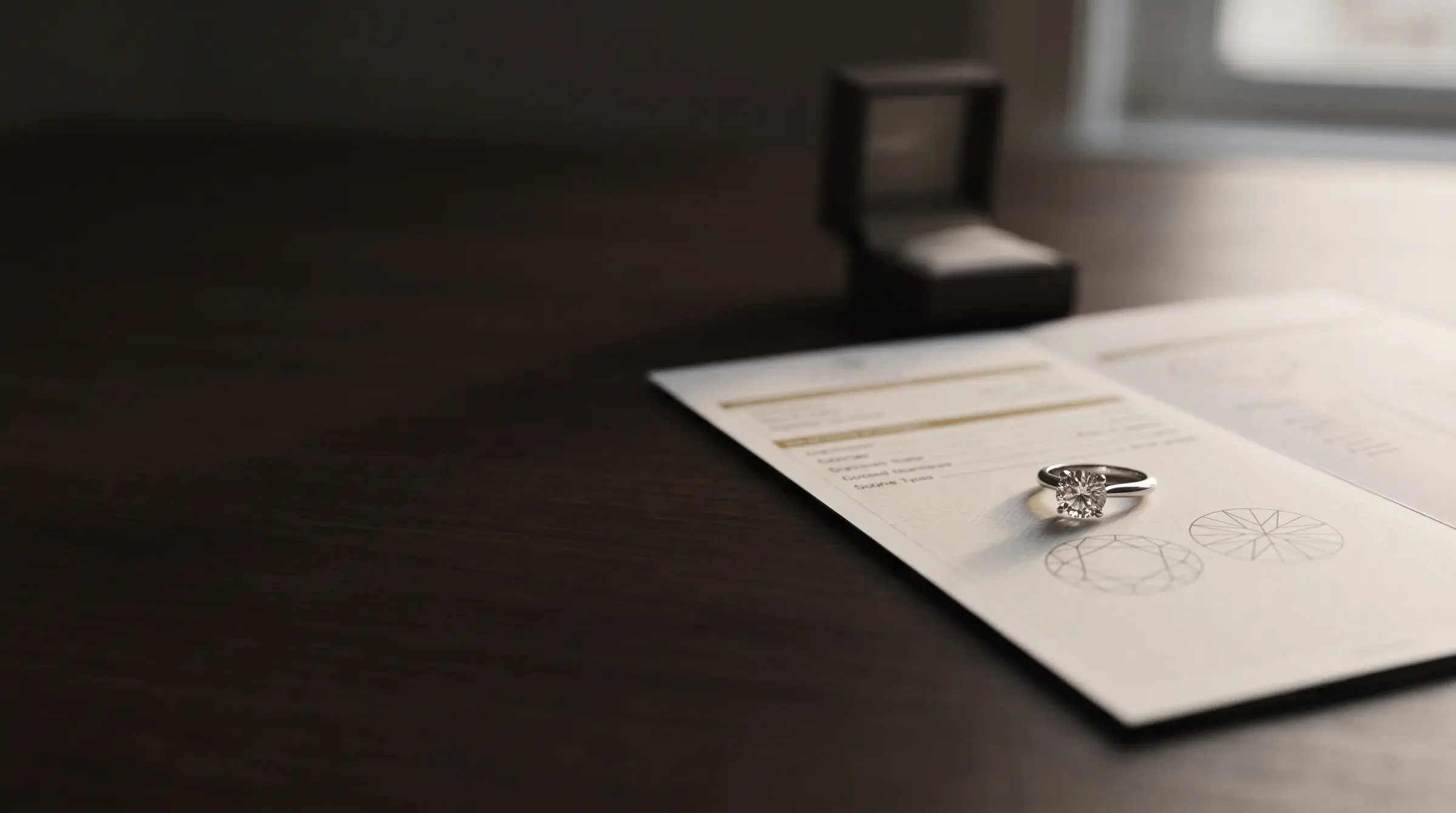
Diamond certificates explained
A diamond certificate tells you everything about the stone in front of you — if you know where to look. Here is how to read one like you have been doing it for years.
Why it matters
A diamond certificate — also called a grading report — is an independent assessment of a diamond's characteristics. It is produced by a gemological laboratory, not by the jeweller selling you the stone. This distinction matters.
Without a certificate, you are trusting the seller's description of the stone. With one, you have a third-party opinion from trained gemologists using standardised grading equipment. The certificate confirms the carat weight, cut grade, colour grade, clarity grade, measurements, and any notable characteristics. It is the single most important document in any diamond purchase.
If a jeweller will not show you the certificate, or says they do not have one, walk away. This is the bare minimum of transparency. A reputable jeweller will hand you the certificate without being asked. If you have to push for it, that tells you something about how they do business.
The three main labs
Three gemological laboratories grade the vast majority of diamonds sold in the UK. Each is reputable, but they are not identical. Here is how they compare.
| GIA | IGI | HRD | |
|---|---|---|---|
| Full name | Gemological Institute of America | International Gemological Institute | Hoge Raad voor Diamant (Antwerp) |
| Based in | USA (Carlsbad, CA) | Belgium (global labs) | Belgium (Antwerp) |
| Best known for | Natural diamonds — the world's most prominent and respected grading laboratory | Lab-grown diamonds — the market leader | European market, strict grading |
| Grading consistency | Very consistent — considered the strictest | Consistent — some consider slightly more generous on colour | Strict — comparable to GIA |
| Our recommendation | For natural diamonds — the global gold standard that buyers and resellers trust most | For lab-grown diamonds — reliable and widely accepted | Perfectly trustworthy — less common in the UK market |
A practical note: GIA-certified natural diamonds typically command a slight premium over IGI-certified ones with the same grades, because the market trusts GIA's consistency more. GIA is the world's most prominent and respected diamond grading laboratory — the gold standard for diamond certification globally. For lab-grown diamonds, IGI is the standard and there is no practical reason to insist on GIA.
Several Hatton Garden jewellers carry GIA certified diamonds, including online-first jewellers that let you search and filter by GIA certificate number before visiting. See our best jewellers guide to find which shops carry GIA-certified stones.
Reading the certificate
Every GIA and IGI certificate follows a standard layout. Here is what you will see and what actually matters when you read it.
The unique identifier for this certificate. This is what you use to verify the report online. Write it down, photograph it, and check it on the lab's website before you buy.
This is the single most important grade on the certificate. Cut determines how much the diamond sparkles — a well-cut diamond reflects light beautifully, while a poorly cut one looks dull regardless of its other grades. Look for "Excellent" or "Very Good." We recommend never going below Very Good. Read our 4Cs guide for the full explanation.
The weight of the diamond measured to two decimal places. A "1 carat" diamond weighs exactly 0.200 grams. The certificate will show the precise weight — for example, 1.03ct or 0.97ct. This matters because prices jump at round numbers: a 0.98ct diamond costs noticeably less than a 1.00ct with the same grades, and they look identical on the finger.
Graded from D (colourless) to Z (noticeable yellow/brown tint). D-F are colourless. G-J are near-colourless — and to the naked eye, you cannot tell the difference from D-F once the diamond is set in a ring. We recommend G or H for the best balance of appearance and value.
Measures the presence of internal inclusions and surface marks. The scale runs from FL (Flawless) to I3 (obvious inclusions visible to the naked eye). VS1-VS2 means inclusions exist under 10x magnification but are not visible to the naked eye. This is what we recommend — "eye-clean" is what matters, not what a microscope reveals.
The certificate shows the diamond's physical dimensions in millimetres, plus proportion details like table percentage and depth percentage. These determine how the diamond looks face-up — a diamond with good proportions will appear larger for its carat weight than one with poor proportions. You do not need to memorise ideal ranges — if the cut grade is Excellent, the proportions are already right.
A diagram showing where any inclusions or marks are located within the diamond. Red marks indicate internal inclusions, green marks indicate surface features. This is useful for verifying you are looking at the right diamond — the pattern of inclusions is unique to each stone, like a fingerprint.
Verify it yourself
Every legitimate certificate can be verified on the issuing lab's website in under a minute. Do this before you hand over any money.
Go to gia.edu/report-check. Enter the report number from the certificate. The website will display the full grading details. Compare what you see on screen to the physical certificate in front of you. They should match exactly.
gia.edu/report-check
Go to igi.org and use their report verification tool. Enter the report number. IGI's system will show you the grading results. This works for both natural and lab-grown diamond reports.
igi.org/verify
Go to myreport.hrdantwerp.com. Enter the report number. HRD's system will display the grading details. Less common in the UK, but equally reliable for stones sourced through European channels.
myreport.hrdantwerp.com
If the report number returns no results, or the details on screen do not match the physical certificate, do not buy that diamond. Either the certificate is forged, or the diamond has been swapped after certification. Both are serious red flags. Walk away and report the jeweller.
Lab-grown diamonds
Lab-grown diamonds are graded using exactly the same criteria as natural diamonds — carat, cut, colour, and clarity. The certificate will clearly state "Laboratory Grown Diamond" or similar wording. The grading methodology is identical.
Most lab-grown diamonds in the UK market are certified by IGI, which has become the de facto standard for lab-grown grading. GIA also grades lab-grown diamonds using the same scale. There is no difference in the rigour of the assessment.
The key thing to understand: a lab-grown diamond with an IGI certificate showing G colour, VS2 clarity, Excellent cut will look identical to a natural diamond with the same grades. The certificate confirms this. The difference is origin and long-term resale value — read our lab-grown vs natural guide for the full picture.
Quick reference
When a jeweller hands you a certificate, here is exactly what to look at, in order.
Excellent or Very Good. Nothing lower.
Write it down. Verify it online before paying.
Matches what the jeweller quoted you? Exact figure, two decimal places.
GIA, IGI, or HRD. If it is an unknown lab, be cautious.
Got a quote and want to check if the price matches the specs? Use our Price Checker — enter the certificate details and we will show you what that diamond typically costs across Hatton Garden.
A certificate proves the diamond. A hallmark proves the metal it's set in. Learn to read a hallmark, and what the one inside your ring should say.
Understanding the certificate is one part of buying a diamond. Here is what else you need to know.
Everything you need to know about buying a diamond — from grades to pricing to what actually matters on the finger
Cut, colour, clarity, carat — what each grade means in practice, not in theory
Same stone, different story. The facts on both, without the sales pitch
GIA (Gemological Institute of America) is the most widely recognised lab globally and is considered the gold standard for natural diamond grading. IGI (International Gemological Institute) has historically been the go-to for lab-grown diamonds and is increasingly respected for natural stones too. HRD (Hoge Raad voor Diamant) is the European equivalent, based in Antwerp. For natural diamonds, we recommend GIA. For lab-grown, IGI is perfectly reliable and is what most jewellers use.
Certificates can be forged, which is why you should always verify them online. GIA certificates can be checked at gia.edu/report-check, IGI at igi.org/verify, and HRD at hrd.be. Enter the report number and the lab's website will show you the exact grading details. If the details on screen don't match the physical certificate, something is wrong. If the report number doesn't exist at all, walk away.
Yes. Lab-grown diamonds are graded using the same criteria — carat, cut, colour, and clarity — and receive the same style of certificate. The certificate will clearly state whether the diamond is natural or laboratory-grown. Most lab-grown diamonds are certified by IGI, though GIA also certifies them. The grading standards are identical.
Walk away. Every reputable jeweller selling a certified diamond should provide the certificate or report number. Some jewellers sell uncertified diamonds — these are not necessarily bad stones, but you have no independent verification of the specs they're claiming. Without a certificate, you're trusting the seller's word on quality. We recommend only buying certified stones from recognised labs.
No. A certificate (also called a grading report) describes the diamond's physical properties — carat, cut, colour, clarity, measurements, and any inclusions. It does not assign a monetary value. A valuation is a separate document, usually prepared by an independent valuer or the jeweller, that states the replacement value of the ring for insurance purposes. You need both: the certificate to verify what you're buying, and a valuation for insurance.