Diamond Shapes Compared
Every shape side by side — how they look on a hand, who they suit, and what they cost per carat
Read guide 6 min
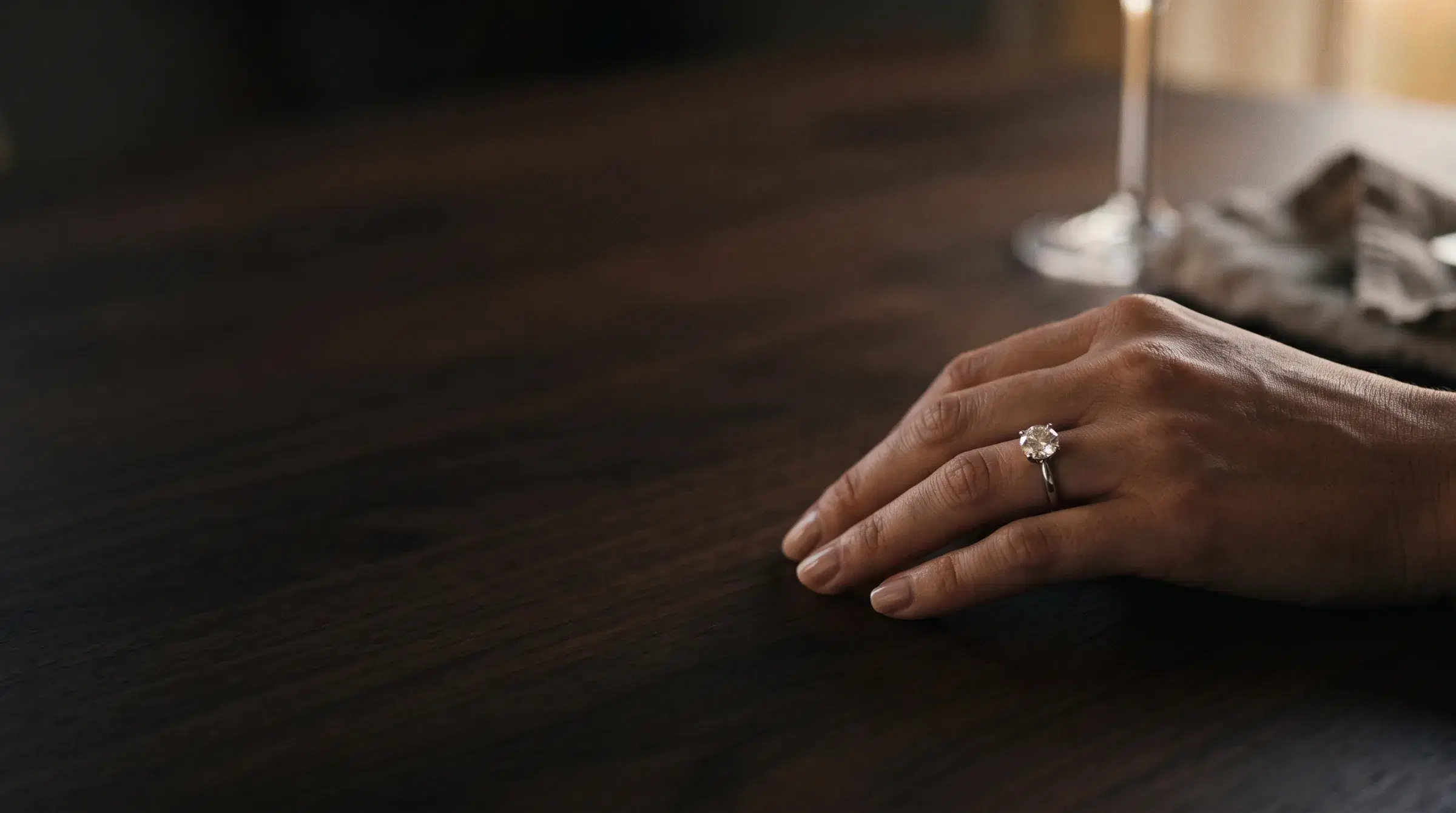
Diamond guide
Every other guide gives you the gemology textbook version. This one tells you what each grade looks like in real life — on a finger, in natural light, from across the dinner table.
The 4Cs — Cut, Colour, Clarity, and Carat — are the universal language for grading diamonds. Every certified diamond in the world gets scored on these four characteristics by an independent laboratory (GIA or IGI, usually). The system works. The problem is how it is taught.
Most guides treat all four Cs as equally important. They are not. One of them affects how the diamond looks on her hand more than the other three combined. Two of them barely matter below a certain grade. And one of them has price jumps at specific thresholds that you can use to your advantage.
This guide is written for the person who wants to understand what they are actually paying for — not to pass a gemology exam, but to walk into a jeweller and know exactly which grades to prioritise and which ones to relax on.
The single most important thing to remember
An Excellent cut 0.9ct diamond will appear more brilliant than a Good cut 1.1ct diamond — cut trumps carat every time. If you remember nothing else from this guide, remember that. The way a diamond is cut determines how it handles light, and light is what makes a diamond look like a diamond.
The 1st C — Most important
Cut is the only one of the 4Cs that is determined by human skill, not by nature. It refers to how well the diamond has been shaped and faceted — the angles, proportions, symmetry, and polish. A well-cut diamond takes in light through the top, bounces it around inside, and sends it back to your eye as sparkle. A poorly cut diamond leaks light out of the bottom and sides, looking dull and lifeless even if it is technically a large, colourless, flawless stone.
This is why cut is the priority. You can have a D colour, Flawless, 2 carat diamond — and if the cut is Poor, it will look like a piece of glass. Conversely, a well-cut 0.7ct diamond in H colour with VS2 clarity will genuinely sparkle and look alive on the hand. Cut is doing all the visual work.
| Grade | What it looks like | Our take |
|---|---|---|
| Excellent / Ideal | Maximum sparkle. Light bounces back evenly. The diamond looks alive from every angle. In direct light, you see bright white flashes and rainbow colours | This is the grade to target. Non-negotiable if your budget allows it |
| Very Good | Nearly as much sparkle as Excellent. Most people cannot tell the difference in normal conditions. Slightly less precision in the facet alignment | A good option if you need to stretch your carat weight slightly. Still looks great on the hand |
| Good | Noticeably less sparkle than Excellent. Some light leaks out instead of returning to your eye. Still a diamond — still sparkles — but the difference is visible side-by-side | We recommend going Excellent or Very Good instead. The price difference is smaller than the visual difference |
| Fair / Poor | Significant light leakage. The diamond looks flat, dull, and glassy. Dark spots visible in certain lighting. Does not look like what most people expect a diamond to look like | Avoid. No matter how large or colourless the stone, a Fair or Poor cut will not deliver the experience you are paying for |
Note on fancy shapes: GIA only gives formal cut grades to round diamonds. For shapes like oval, cushion, emerald, and pear, you need to look at symmetry and polish grades (both should be Very Good or Excellent) and — ideally — see the diamond in 360-degree video or in person. Online-first jewellers like MOH London typically provide 360-degree videos for every stone in their database.
The 2nd C — Less visible than you think
Diamond colour is graded on a scale from D (completely colourless) to Z (noticeably yellow or brown). The scale starts at D because before GIA standardised it, jewellers used vague terms like “A quality” and “AAA quality” that meant nothing consistent. D was a fresh start.
Here is the thing most guides do not tell you clearly: the difference between D and H is essentially invisible on the hand in a white setting. You can see it in a lab, on a pure white background, with the diamond face-down. You cannot see it across the dinner table. The human eye starts noticing warmth around I-J grade, and it only becomes obvious at K and below.
| Grade | On the hand | Best in | Price premium |
|---|---|---|---|
| D-E | Completely colourless. No warmth whatsoever. Looks like ice | Platinum or white gold | Highest. 15-25% more than G-H |
| F-G | Near-colourless. Indistinguishable from D-E when set in a ring and viewed face-up | Any metal | Moderate premium. Best value for white metals |
| H-I | Very faint warmth. Most people cannot detect it face-up in a setting. Side-by-side with D, a trained eye might notice | Yellow or rose gold | Good value. The smart choice for gold settings |
| J-K | Warmth becomes detectable. In white metal, most people will notice a slight yellow tone in certain lighting | Yellow gold only | Significantly less. Only suitable if the warm metal masks it |
Our recommendation: G or H in white gold or platinum. I or J in yellow or rose gold. You will not see the difference from higher grades, and the money you free up can go toward a better cut or a slightly larger stone — both of which you will see.
The full chart, grade by grade: diamond colour from D to Z. Don't take our word for it, either. Try to spot E from G, or D from H in our two-minute diamond test.
The 3rd C — Invisible below VS2
Clarity measures the internal characteristics (called inclusions) and surface blemishes in a diamond. Every natural diamond has them — they formed under extreme heat and pressure deep in the earth. The clarity grade tells you how visible these inclusions are under 10x magnification. Not to the naked eye. Under magnification.
This is the key insight: the difference between Flawless and VS2 is invisible to anyone looking at the ring in normal conditions. The inclusions in a VS2 diamond are microscopic — you need a jeweller's loupe to find them, and even then, you have to know where to look. For the overwhelming majority of buyers, clarity above VS2 is paying a premium for something that exists only on the certificate.
| Grade | What it means | Can you see it? |
|---|---|---|
| FL / IF | Flawless / Internally Flawless. No inclusions visible at 10x magnification | No. Identical to VS2 on the hand. Extremely rare and priced accordingly |
| VVS1 / VVS2 | Very, Very Slightly Included. Inclusions are difficult to see even under 10x magnification | No. Even a trained gemologist needs time to find them under a loupe |
| VS1 / VS2 | Very Slightly Included. Inclusions are visible under 10x magnification but minor | No. This is the sweet spot — eye-clean with a significant price advantage over VVS |
| SI1 | Slightly Included. Inclusions are noticeable under 10x magnification | Possibly. Depends on the stone — some SI1 diamonds are eye-clean, some are not. Always view the specific stone |
| SI2 / I1 | Inclusions are obvious under magnification and may be visible to the naked eye | Often yes. Dark spots or cloudy patches may be visible on the hand. We recommend avoiding these for engagement rings |
Our recommendation: VS2 for round diamonds. VS1 for step-cut shapes like emerald and Asscher, because their large, open facets make inclusions slightly more visible. Never go above VS1 unless you specifically want the certificate to say VVS or Flawless — which is a perfectly valid reason, just know that it is an emotional choice, not a visual one.
One exception: SI1 can be a smart choice if you can view the specific diamond first. Some SI1 stones have their inclusions off to the side where a prong will cover them, or the inclusions are white and invisible against the diamond. But you have to see the stone — never buy an SI1 sight-unseen.
Every grade from Flawless to I3, in a ring and under a loupe, is in our diamond clarity chart. Or see it for yourself: compare VVS1 with VS1 through a 10x loupe, then see where SI2 starts to show.
The 4th C — Size and the price jumps
Carat is the weight of the diamond, not the size. One carat equals 0.2 grams. But because diamonds are cut to fairly standard proportions, carat weight does correlate with physical size — a larger carat weight generally means a larger face-up diameter. A 1 carat round diamond measures approximately 6.5mm across. A 0.5 carat round measures approximately 5.1mm.
Carat is the C that most people fixate on, and it is also the one with the most interesting pricing quirks. Understanding how the market prices carat weight gives you a genuine advantage.
Diamond prices jump significantly at whole and half-carat marks. A 1.00ct diamond costs meaningfully more per carat than a 0.95ct diamond — even though the two are visually indistinguishable. This happens because demand clusters around round numbers. Everyone wants a “one carat diamond.” Almost nobody asks for 0.93 carats.
| Threshold | Just below | Size difference | Price difference |
|---|---|---|---|
| 0.50ct | 0.45-0.49ct | Less than 0.3mm in diameter | 10-15% lower price per carat |
| 1.00ct | 0.90-0.99ct | Less than 0.4mm in diameter | 15-25% lower price per carat |
| 1.50ct | 1.40-1.49ct | Less than 0.3mm in diameter | 10-20% lower price per carat |
| 2.00ct | 1.90-1.99ct | Less than 0.3mm in diameter | 20-30% lower price per carat |
A 0.92ct diamond looks identical to a 1.00ct diamond — the 0.4mm difference in diameter is invisible to the human eye. But the price difference is real. This is one of the few places in diamond buying where simply knowing how the market works gives you a concrete advantage.
Not all 1 carat diamonds look the same size. Elongated shapes like oval, marquise, and pear have a larger face-up surface area than round and square shapes at the same carat weight. If visual size matters more to you than weight on the certificate, consider an oval — a 0.8ct oval can appear as large as a 1ct round.
See what each carat weight looks like. Our diamond size pages show realistic on-hand comparisons for every shape and carat combination, so you know what you are actually getting before you walk into a shop.
See 1 carat round on handPutting it together
When you are working within a fixed number, here is the priority order we recommend. This maximises what you see on the hand — not what looks impressive on paper.
Cut — Protect this at all costs
Excellent or Very Good. This is what makes a diamond look like a diamond. Never compromise here.
Carat — Get the size you want
Choose your target size, then look just below the threshold (e.g. 0.90-0.99 instead of 1.00) to free up budget.
Colour — Match it to your metal
G-H for white metals, I-J for yellow/rose gold. Going higher adds cost without visible improvement.
Clarity — VS2 and move on
VS2 is eye-clean. VS1 for emerald and Asscher cuts. Everything above is paying for the certificate, not the appearance.
Recommended specifications
If you want a simple answer — the specs that give you the best visual result without paying for things you cannot see — here they are:
In white gold or platinum
In yellow or rose gold
These specs will give you a diamond that looks brilliant on the hand, appears colourless in its setting, and has no visible inclusions. The certificate might not say D Flawless — but the ring on her finger will look exactly as you want it to.
One more thing
The 4Cs only mean something if they are graded by an independent laboratory. A jeweller telling you “this is an F colour VS1” means nothing without a third-party certificate to back it up. The two laboratories to trust are:
If a jeweller cannot provide a GIA or IGI certificate, ask why. There may be a legitimate reason (very small diamonds under 0.3ct are not always individually certified). But for any diamond over 0.5ct in an engagement ring, a certificate is non-negotiable.
Want to know how to read a certificate? Our certification guide walks you through every section of a GIA and IGI report in 30 seconds — what matters and what you can skip.
Read the Certification GuideNow that you know how the 4Cs work in practice, you can search with confidence. Use our comparison tool to put two diamonds side-by-side and see which one is actually worth the difference — or check whether a quote you have received is fair.
Cut. It is the only C that determines how a diamond handles light — how much it sparkles, how much fire it shows, how alive it looks on the hand. A well-cut 0.9ct diamond will look more brilliant than a poorly cut 1.1ct diamond. If you have to compromise anywhere, protect the cut grade above everything else.
G or H. In a white gold or platinum setting, G and H diamonds appear colourless to the naked eye. The warmth only becomes noticeable around J-K. Paying the premium for D or E colour gives you a higher grade on the certificate with no visible difference on the hand. In yellow gold settings, you can comfortably go to I or J — the warm metal masks any slight colour.
No — not without magnification. VS2 stands for Very Slightly Included, and the inclusions are only visible under 10x magnification. On the hand, in normal lighting, a VS2 diamond looks identical to a Flawless diamond. Most jewellers will tell you the same thing: VS2 and above is considered "eye-clean" for nearly all diamond shapes.
It depends on the shape and the hand size. A 1 carat round diamond measures about 6.5mm across — it is noticeable and substantial without being oversized. On smaller hands, 0.7-0.8ct can look perfectly proportioned. On larger hands, 1.2-1.5ct may feel right. Remember that oval and pear shapes appear larger per carat than round, so a 0.8ct oval can look as big as a 1ct round.
Because the 4Cs are grades, not exact measurements. Two G-colour VS2 diamonds can have slightly different tone placements within the G range, and the inclusions in each VS2 stone will be in different positions with different characteristics. This is why you should always see a diamond in person or in 360-degree video before buying — the certificate tells you the grade, but your eyes tell you how it actually looks.
Go deeper on diamonds, shapes, and how to make your decision.
Every shape side by side — how they look on a hand, who they suit, and what they cost per carat
The full diamond buying guide — from certification to pricing, everything in one place
How to read a GIA or IGI certificate in 30 seconds — what each section means and what to check first
The complete walkthrough — what to decide first, what can wait, and what does not matter as much as you think
Same stone scientifically. Different story emotionally. The full picture including the trade-offs
Real price ranges by ring type, metal, and carat. No vague language — actual numbers