Platinum, White, Yellow or Rose Gold?
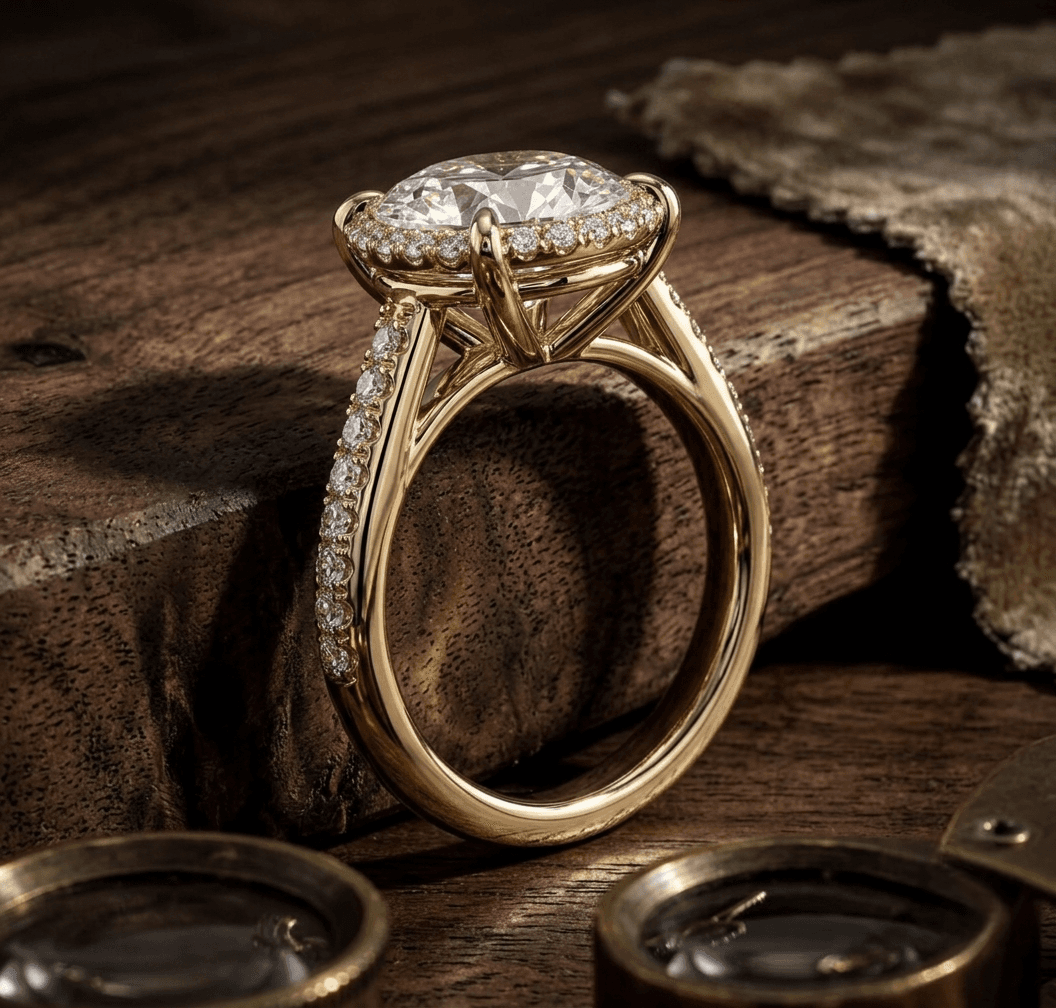
What each metal looks like after a year of daily wear, and what it costs
Read guide 6 min
Hallmarks
A UK hallmark tells you exactly what metal you've bought, how pure it is, and that someone independent has tested it. Here's how to read one, plus a decoder for the marks on your own jewellery.
In short: the number is the purity in parts per 1,000. 375 is 9ct gold, 750 is 18ct gold, 925 is sterling silver and 950 is usually platinum. Next to it, a leopard's head, anchor, rose or castle shows which assay office tested it. Without that symbol, the number is just the maker's claim.
Hallmark decoder
How to read a hallmark
Every UK hallmark has three compulsory parts. They're tiny, usually on the inside of a ring's band, and read left to right.
At least two letters in a shield: the company that made or sent the piece to be tested. No two are the same at one assay office.
A number in parts per 1,000, such as 375 or 950. The shape of the outline around it shows the metal: gold, silver, platinum or palladium.
A symbol showing where it was tested: a leopard’s head (London), anchor (Birmingham), rose (Sheffield) or castle (Edinburgh).
You may also see optional marks: a traditional symbol for the metal (a crown for gold, a lion for sterling silver, an orb for platinum), and a date letter, which was compulsory until 1999 and changes every 1 January.
What the numbers mean
These are the only numbers a UK assay office will hallmark. Anything else is not a UK standard.
| 375 | 9 carat gold (37.5%)The lowest legal gold standard in the UK. Harder-wearing than higher carats, but paler and less valuable. |
| 585 | 14 carat gold (58.5%)Common in the US and Europe, less so in the UK. A middle ground between 9ct and 18ct. |
| 750 | 18 carat gold (75%)The usual standard for engagement rings in the UK. Richer colour than 9ct, and it holds its value better. |
| 916 | 22 carat gold (91.6%)Rich yellow and soft. Traditional in South Asian jewellery; too soft for a ring set with stones. |
| 990 | 99% pure gold (99%)Almost pure gold. Very soft, so rarely used for jewellery worn every day. |
| 999 | 24 carat (fine) gold (99.9%)Pure gold. Too soft for most jewellery; mainly coins and bars. |
Must be hallmarked above 1 gram
| 850 | 850 platinum (85%)The lowest legal platinum standard. |
| 900 | 900 platinum (90%)A platinum standard used by some makers. |
| 950 | 950 platinum (95%)The usual standard for platinum engagement and wedding rings in the UK. |
| 999 | Pure platinum (99.9%)Almost pure platinum. Rare in jewellery. |
Must be hallmarked above 0.5 grams
| 800 | 800 silver (80%)The lowest legal silver standard. Mostly older continental pieces. |
| 925 | Sterling silver (92.5%)The standard for most silver jewellery. The sterling standard dates back to a statute of 1300. |
| 958 | Britannia silver (95.8%)A higher silver standard than sterling, and a little softer. |
| 999 | Fine silver (99.9%)Pure silver. Very soft; used for some jewellery and bullion. |
Must be hallmarked above 7.78 grams
| 500 | 500 palladium (50%)The lowest legal palladium standard. |
| 950 | 950 palladium (95%)The usual standard for palladium rings: a lighter, white alternative to platinum. |
| 999 | Pure palladium (99.9%)Almost pure palladium. Rare in jewellery. |
Must be hallmarked above 1 gram
The assay offices
There are four assay offices in the UK. Each one tests the metal, then strikes its own symbol into the piece.
Leopard’s head
Tested at the London Assay Office at Goldsmiths’ Hall, the hall that gave the word “hallmark” its name. It’s under a mile from Hatton Garden.
Anchor
Tested at the Birmingham Assay Office.
Yorkshire rose
Tested at the Sheffield Assay Office.
Castle
Tested at the Edinburgh Assay Office, the only one in Scotland.
The Hatton Garden connection
The word comes from Goldsmiths' Hall, the home of the Goldsmiths' Company on Foster Lane in the City of London. Precious metal was brought to the hall to be tested and marked, and the London Assay Office still does that work there today.
It's less than a mile from Hatton Garden. When a Hatton Garden jeweller sends a ring to London for hallmarking, it comes back with the leopard's head: the same mark London silver has carried for centuries, since England first set a legal standard for silver in 1300.
Buying an engagement ring
Still choosing a metal? Compare them in our guide to ring metals.
Optional, but common. They sit alongside the number.
If you see these instead of a number, it isn't solid gold.
The metal is half the ring. Here's the other half.
What each metal looks like after a year of daily wear, and what it costs
The hallmark proves the metal. A GIA or IGI report proves the stone
How London’s diamond quarter grew up less than a mile from Goldsmiths’ Hall
375 means 9 carat gold: 375 parts in every 1,000 (37.5%) are pure gold, and the rest is other metals that make it harder. It is the lowest standard that can legally be sold as gold in the UK.
750 means 18 carat gold, which is 75% pure gold. It is the usual standard for engagement rings in the UK.
925 means sterling silver, which is 92.5% pure silver. The sterling standard was set in England by a statute of 1300.
Yes. 9 carat (375) gold is real gold, 37.5% pure, and it can be hallmarked and sold as gold in the UK. It is harder-wearing than 18ct, but paler in colour and worth less.
In the UK, look for a full hallmark: a maker’s mark, a number such as 375 or 750, and an assay office symbol (a leopard’s head, anchor, rose or castle). That means the metal has been independently tested. A number on its own is only the maker’s claim. If there’s no hallmark, a jeweller can test it, or you can send it to an assay office.
Not all of it. In the UK, items under 1 gram of gold, 7.78 grams of silver, 0.5 grams of platinum or 1 gram of palladium don’t need a hallmark, and items made before 1950 can be sold without one. Anything heavier must be hallmarked to be described as gold, silver, platinum or palladium.
A leopard’s head. It shows the piece was tested at the London Assay Office at Goldsmiths’ Hall, the hall that gave the word “hallmark” its name.
Sometimes. The date letter was compulsory until 1999 and is now optional. If there is one, it changes every year on 1 January, and the style of the letter and its outline tell you the year.