Lab-Grown Diamonds in Hatton Garden
Which jewellers stock them, how to compare, and what to ask
Read guide 6 min
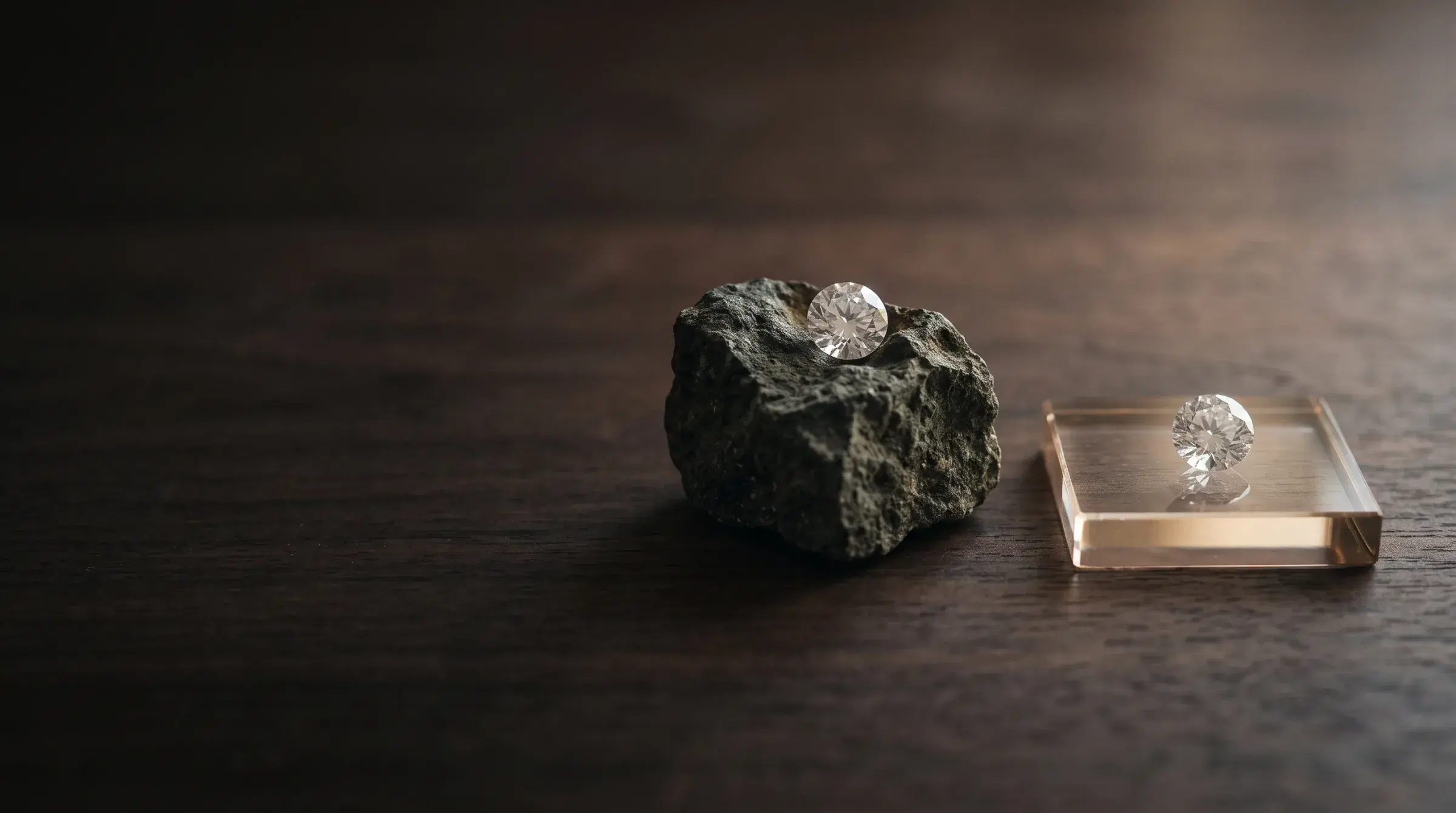
The full guide
Same carbon. Same crystal. Same sparkle. Different origin, different price, different resale story. Here's everything you actually need to know — honestly.
The science
Let's start with what nobody in the jewellery trade wants to say this plainly: a lab-grown diamond and a natural diamond are physically, chemically, and optically identical. Not similar. Identical. Same crystal structure. Same hardness — 10 on the Mohs scale, the hardest natural material on Earth. Same refractive index. Same thermal conductivity. If you put one of each under a standard jeweller's loupe, you cannot tell them apart.
The difference is where they form. Natural diamonds crystallise deep underground — 150-200km below the surface — under extreme pressure and temperature over 1-3 billion years. They're brought to the surface by volcanic eruptions and mined from kimberlite pipes.
Lab-grown diamonds are created in a controlled environment that replicates those conditions. The process takes 2-4 weeks instead of a billion years. The end result is the same crystal — just with a different story behind it.
How they're made
Lab-grown diamonds are produced using two established methods. Both create real diamonds — the method affects the production economics, not the final product.
Price comparison
These are real Hatton Garden price ranges for round brilliant diamonds with good-to-excellent cut, G-H colour, VS1-VS2 clarity. Prices vary by jeweller, but these ranges reflect what you'll find when you shop.
| Carat | Natural diamond | Lab-grown diamond | Difference |
|---|---|---|---|
| 1.0ct round | £4,000-£7,000 | £800-£1,500 | 70-80% less |
| 1.5ct round | £8,000-£14,000 | £1,200-£2,500 | 75-85% less |
| 2.0ct round | £15,000-£30,000 | £2,000-£4,000 | 80-87% less |
Note: These are stone-only prices. Add £400-£900 for the setting depending on metal choice. See our metals guide for setting costs.
Certification
One of the most common misconceptions is that lab-grown diamonds aren't properly certified. They are. Both GIA (Gemological Institute of America) and IGI (International Gemological Institute) grade lab-grown diamonds using exactly the same 4Cs framework they use for natural stones: carat weight, cut grade, colour grade, and clarity grade.
The certificate will state the origin clearly — "Laboratory-Grown Diamond" appears at the top of the report. Many lab-grown diamonds also carry a microscopic laser inscription on the edge of the stone, readable under magnification, that links to the certificate number.
For a deeper look at what a diamond certificate tells you (and what it doesn't), read our guide to the 4Cs.
Whether you're buying natural or lab-grown, never buy a diamond without an independent certificate from GIA or IGI. A "house certificate" from the jeweller themselves is not the same thing — it's their own grading, not a third-party assessment. If a jeweller can't provide a GIA or IGI report, find a different jeweller.
The trade-offs — honestly
We're not here to sell you on lab-grown or talk you out of natural. We're here to make sure you understand the trade-offs before you spend thousands of pounds. Every one of these points matters.
This is the most important trade-off, and we want to be completely clear about it. Natural diamonds hold roughly 30-50% of their purchase price on the second-hand market. Lab-grown diamonds hold very little — in many cases, you may struggle to resell one at all, because a buyer can purchase a new lab-grown stone for less than what you originally paid.
If you're buying an engagement ring as a symbol of commitment that you intend to wear forever, resale may not matter to you. But if you think of a diamond as something that holds its value over time — like a financial asset — natural is the only option that partially delivers on that expectation. We say "partially" because even natural diamonds are not great investments. You'll never sell one for what you paid retail.
For some people, the fact that a diamond formed underground over a billion years is part of its meaning. The age, the rarity, the geological story — this adds emotional value that a lab-created stone, however identical, does not carry. That feeling is valid. It's not irrational, and it's not something we'd try to talk anyone out of.
If she (or you) feels strongly that a "real" diamond means one from the ground — that settles it. The ring is a symbol, and symbols carry meaning beyond chemistry.
Lab-grown diamonds avoid the land disruption, water usage, and community displacement associated with large-scale diamond mining. That's a genuine advantage. But lab-grown production is not zero-impact — the HPHT and CVD processes are energy-intensive, and the environmental footprint depends heavily on the energy source used by the specific production facility.
Some producers use renewable energy and can demonstrate a significantly lower carbon footprint. Others use grid electricity in countries with coal-heavy energy mixes, which narrows the gap. If environmental impact matters to you, ask the jeweller about the specific sourcing — don't assume "lab-grown" automatically means "green."
Lab-grown diamond prices have fallen consistently over the past five years, and this trend shows no sign of stopping. Production capacity is increasing globally — particularly in India and China — and the technology keeps improving, making larger and higher-quality stones easier to produce.
What this means practically: the lab-grown diamond you buy today for £1,200 might be available for £800 in two years. This doesn't affect the beauty or quality of your stone — but it does affect how you feel about the price you paid. It's the same dynamic as buying any technology product: it gets better and less costly over time.
Having the conversation
If the proposal is a surprise but the ring is a joint decision, or if you want to gauge her feelings before committing to natural or lab-grown, here's how to bring it up without making it a loaded question.
The key: Don't frame lab-grown as the "cheaper option." Frame it as a different choice — with different trade-offs. If she wants a natural diamond, respect that. If she'd rather put the difference toward a honeymoon, a house, or a bigger stone, respect that too.
Where to buy
Not every Hatton Garden jeweller stocks lab-grown diamonds — some traditional shops actively resist them. But the shift is happening, and several well-regarded jewellers now offer both options or specialise in lab-grown.
Online-first Hatton Garden jewellers have invested heavily in lab-grown. Their online platforms let you search, filter, and compare lab-grown diamonds from global databases — with full GIA or IGI certification on every stone. You can configure your entire ring online, see the price, and book an appointment to see the stone in person. This approach gives you the most transparent comparison between natural and lab-grown pricing.
Some traditional Hatton Garden jewellers now stock both natural and lab-grown — but the selection of lab-grown in-store is often limited compared to what online-first jewellers can source. If you go this route, ask specifically to see lab-grown options and compare them side by side with natural stones at the same specs. Watch for jewellers who actively steer you away from lab-grown — they may have a financial incentive to sell natural rather than your best interest at heart.
For a full breakdown of Hatton Garden jewellers — who they are, what they specialise in, and who we recommend — see our best jewellers guide.
Summary
Everything from this guide in one table.
| Natural diamond | Lab-grown diamond | |
|---|---|---|
| Composition | Pure crystallised carbon | Pure crystallised carbon |
| Hardness | 10 Mohs | 10 Mohs |
| Optical properties | Identical | Identical |
| Certification | GIA / IGI — full 4Cs grading | GIA / IGI — full 4Cs grading |
| Origin | Mined — 1-3 billion years underground | Laboratory — 2-4 weeks |
| 1ct price (G-H, VS) | £4,000-£7,000 | £800-£1,500 |
| Resale value | 30-50% of purchase price | Very low — often near zero |
| Environmental impact | Mining — land and water impact | Energy-intensive — varies by source |
| Price trend | Relatively stable | Declining as production scales |
| Insurance | Fully insurable | Fully insurable |
Our recommendation
We've shown you the facts. Here's our honest opinion.
We think lab-grown diamonds are worth considering for most buyers — but only if you've understood the resale implications and you're at peace with them.
Whatever you choose — make sure it comes with an independent certificate, make sure you understand the specs, and make sure you've compared prices from at least three jewellers. That's what actually protects you, regardless of origin.
Understand the full picture before you shop.
Which jewellers stock them, how to compare, and what to ask
Everything you need to know about buying a diamond in Hatton Garden
Know what you're looking at before a jeweller explains it to you on their terms
Durability, maintenance, and what your ring actually looks like after a year
Real price ranges so you know whether a quote is fair before you hear it
Prices, styles, and how to walk in with confidence instead of confusion
Not with the naked eye — they are physically, chemically, and optically identical. A jeweller needs specialised equipment (like a DiamondSure or DiamondView machine) to detect the subtle growth patterns that distinguish lab-grown from natural. Even under a standard loupe, they look the same. This is why certification from GIA or IGI matters — the certificate states the origin clearly.
Yes. Lab-grown diamonds are real diamonds — they have the same thermal and electrical conductivity as natural diamonds, so they pass standard diamond testers. Older testers that only measure thermal conductivity will read "diamond" for both. Newer testers designed specifically to distinguish origin can tell them apart, but these are specialist tools, not standard equipment.
They have been falling steadily as production technology improves and scales up. A 1ct lab-grown that cost £3,000 in 2020 can be found for £800-£1,500 today. Whether this trend continues depends on supply and demand dynamics — but the trajectory has been consistently downward. This is one reason resale value is low: a buyer can buy new for less than you paid.
Yes. Both GIA and IGI grade lab-grown diamonds using the same 4Cs framework — carat, cut, colour, and clarity. The certificate will clearly state "Laboratory-Grown Diamond" at the top, and many lab-grown diamonds also have a microscopic laser inscription on the edge that identifies them. The grading methodology is identical.
Yes — all major UK jewellery insurers cover lab-grown diamonds. The ring is insured for its replacement value, which is based on the current market price of a comparable lab-grown diamond, not the price you originally paid. Because lab-grown prices have been decreasing, your insured value may be lower than what you paid — but the ring is fully coverable.
Yes, in every physical sense. It is pure crystallised carbon with the same atomic structure, the same hardness (10 on the Mohs scale), the same refractive index, and the same thermal properties as a natural diamond. The only difference is origin: one formed underground over billions of years, the other formed in a laboratory over 2-4 weeks. Both are real diamonds. The FTC in the US confirmed this in 2018 by removing "natural" from the definition of "diamond."