Diamond Clarity Chart
FL to I3: which marks you can see in a ring, and the grade to pick for your shape
Read guide 7 min
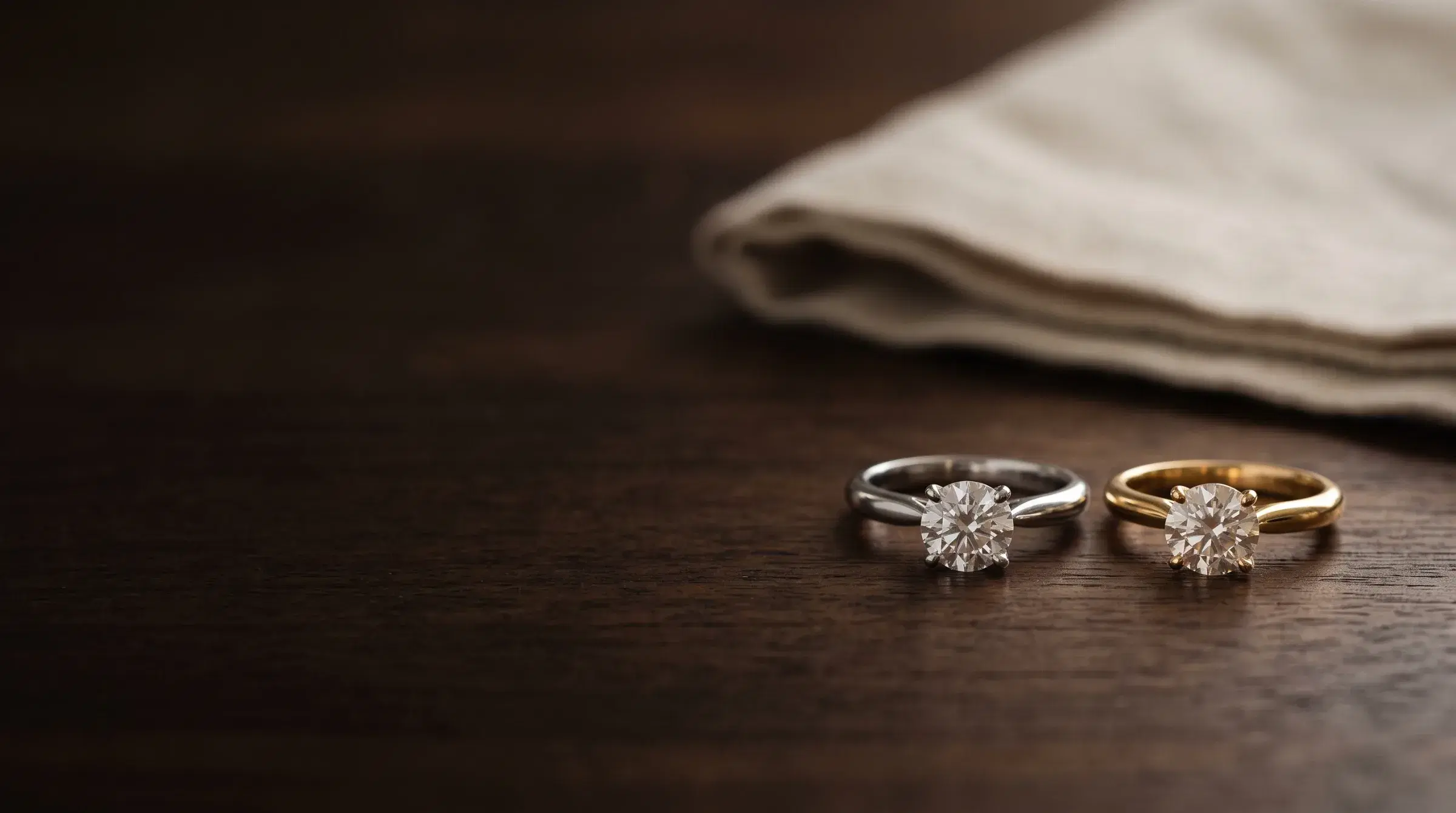
Diamond colour
The colour scale runs from D to Z, but most of it is invisible once a diamond is in a ring. Here's the whole chart, what each grade looks like on the hand, and the one to pick for your metal.
The short answer: choose G or H for platinum or white gold, and I or J for yellow or rose gold. D to F cost more and look the same once set. Spend the difference on a better cut, which you will see.
The colour chart
Colour grades measure how white a diamond is. D has no colour at all; each letter after it has a little more warmth. The scale is split into five bands, and the line that matters for an engagement ring falls in the middle of the second one.
Colourless D–F
Icy white. Next to G or H in a ring, you won’t see the difference.
Near colourless G–J
G and H look white in any metal. I and J can show a faint warmth in platinum or white gold, mostly next to a whiter stone.
Faint K–M
A noticeable warm tint in white metal. Some people choose it on purpose for a vintage look.
Very light N–R
Clearly yellow or brown. Rare in engagement rings.
Light S–Z
Obvious colour. Beyond Z, a diamond counts as a “fancy” coloured diamond, graded on a different scale.
How colour is graded
A grader at GIA or IGI lays the loose diamond upside down on a white tray, under controlled daylight lamps, and compares it with a set of reference stones of known grades. Upside down, nothing distracts from the body colour, so differences of one grade become visible to a trained eye.
That's not how anyone sees a diamond in a ring. Face-up, the sparkle bouncing around inside the stone hides most of its body colour. That's why two or three grades that are clearly different on the grading tray look the same on a hand.
Natural and lab-grown diamonds are graded on the same scale. A G is a G, whichever way it was made. And a colour grade is a different thing from a coloured diamond: pink, blue and yellow “fancy” diamonds have a scale of their own.
What changes it
The grade on the certificate is only half the story. The same H can look whiter or warmer depending on these.
The biggest one. Yellow and rose gold reflect their own warmth into the diamond, which swamps a faint tint. Platinum and white gold do the opposite: they make any warmth easier to spot. Read our guide to ring metals if you haven't chosen yet.
Round diamonds hide colour best, because they sparkle the most. Emerald, Asscher and cushion shapes show more of the body colour, and the pointed ends of oval, pear and marquise shapes can look a shade warmer. For those, go one grade higher.
Bigger diamonds hold more colour, simply because light travels further through them. An I that looks white at 0.7ct can look a little warm at 2ct. Above 1.5ct in white metal, we'd stay at H or above.
A well-cut diamond returns more light to your eye, and that light masks colour. A poorly cut one looks darker and shows its tint more. This is why we say spend on cut before colour: a better cut makes the colour look better too.
Our recommendation
For a well-cut round diamond up to about 1.5ct. For fancy shapes or bigger stones, add one grade.
| Metal | We recommend | Why |
|---|---|---|
| Platinum | G or H | White metal shows any warmth in the stone. G and H still look white. |
| White gold | G or H | Same as platinum. White gold is plated white, so it reads the same. |
| Yellow gold | I or J | The metal reflects warmth into the diamond, so higher grades are wasted. |
| Rose gold | I or J | Same as yellow gold. The pink tone hides a faint warmth completely. |
In Hatton Garden, D to F typically cost 15–25% more than G to H with everything else the same. You pay that for a letter on the certificate, not for anything you'll see. See what different specs cost in our Hatton Garden price guide.
Grade by grade
Try it yourself
4 pairs, one grade apart. Pick the one you think costs more, or say they look the same, then see whether anyone could tell in a ring.
4 rounds, about a minute. Each pair differs by one grade. Pick the one you think costs more, or say they look the same if you can't tell. Then we show you what changed, and whether anyone could see it in a ring.
Colour is one of four grades. Here's how the others fit in.
FL to I3: which marks you can see in a ring, and the grade to pick for your shape
Cut, colour, clarity and carat: what each one changes, and what it costs
What each metal looks like after a year of daily wear, and what it costs
D is the highest grade, but it is not the best value. In a ring, D, E and F look the same as G and H. We recommend G or H for platinum and white gold, and I or J for yellow and rose gold. You will not see the difference from higher grades, and the money is better spent on cut.
Yes. G is the top of the near-colourless range and looks white in any metal. It is the grade we recommend most often for platinum and white gold, because it looks the same as D to F face-up in a ring.
Yes, for most rings. H looks white in platinum, white gold, yellow gold and rose gold. Side by side with a D under bright light, a trained eye might notice a touch of warmth. On its own, in a ring, it reads as white.
In yellow or rose gold, no: the metal hides it. In platinum or white gold, many people notice a faint warmth, especially next to a whiter stone. If you want a white-metal ring, we recommend staying at I or above.
D is the top of the GIA colour scale: completely colourless. It is the rarest and most expensive grade. D, E and F are all graded colourless, and none of them look different from a G once set in a ring.
In Hatton Garden, D to F diamonds typically cost 15–25% more than G to H with the same cut, clarity and carat. Because you can’t see the difference in a ring, that premium buys a better certificate, not a better-looking stone.
Yes. Lab-grown diamonds are graded on the same D to Z scale, usually by IGI or GIA. A G lab-grown diamond looks the same as a G natural one. The colour advice in this guide applies to both.
Those are “fancy” coloured diamonds, and they are graded on a separate scale where stronger colour is worth more. The D to Z scale in this guide is only about how white a diamond is. Among natural fancy colours, red is the rarest.