White Gold vs Platinum vs Rose Gold
The full comparison of traditional precious metals for rings — durability, maintenance, and real prices
Read guide 6 min
Ring metals guide
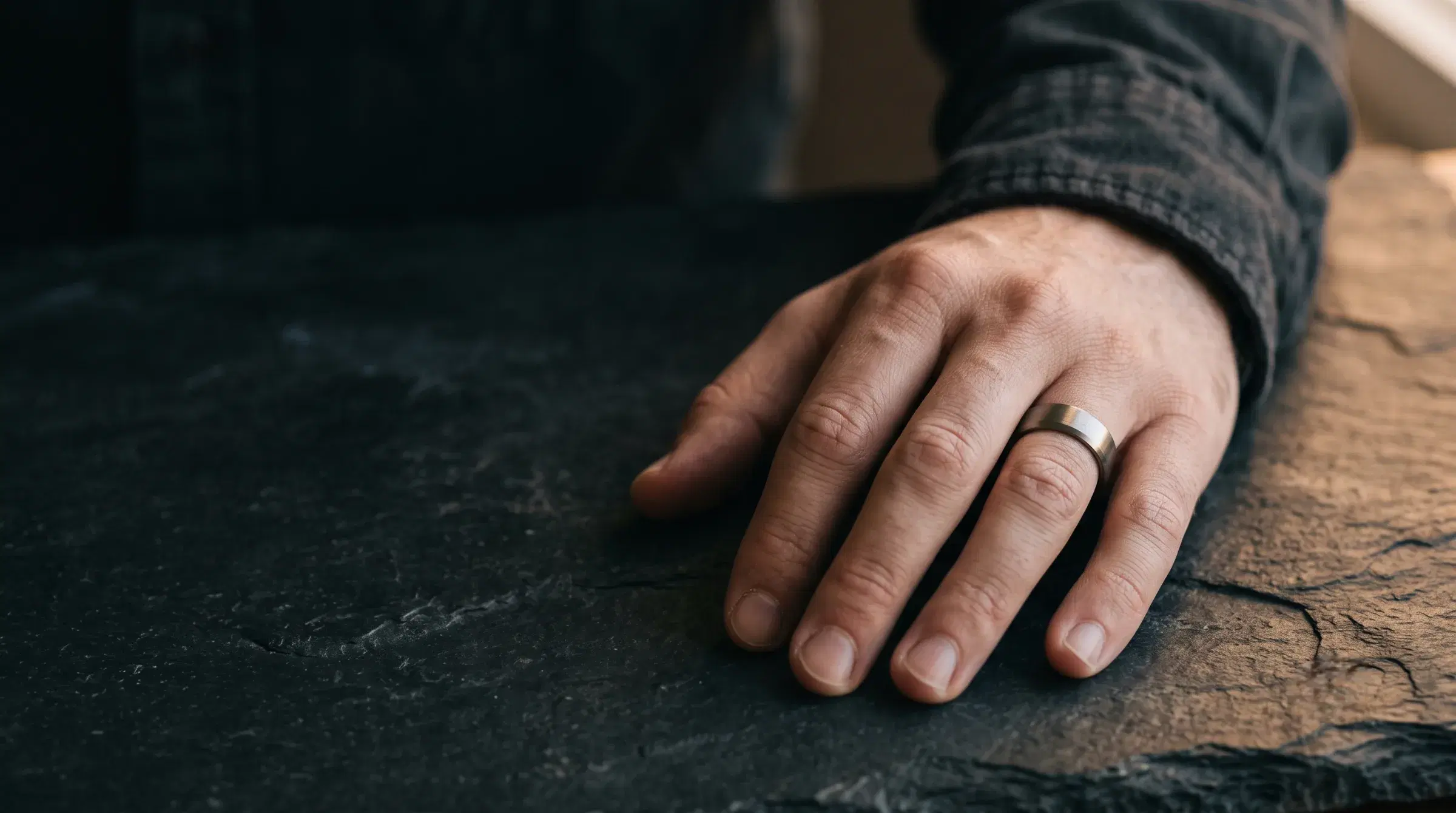
Titanium is the fastest-growing category in men's wedding bands. Lighter than gold, stronger than steel, and completely hypoallergenic. Here's what you need to know before buying.
The material
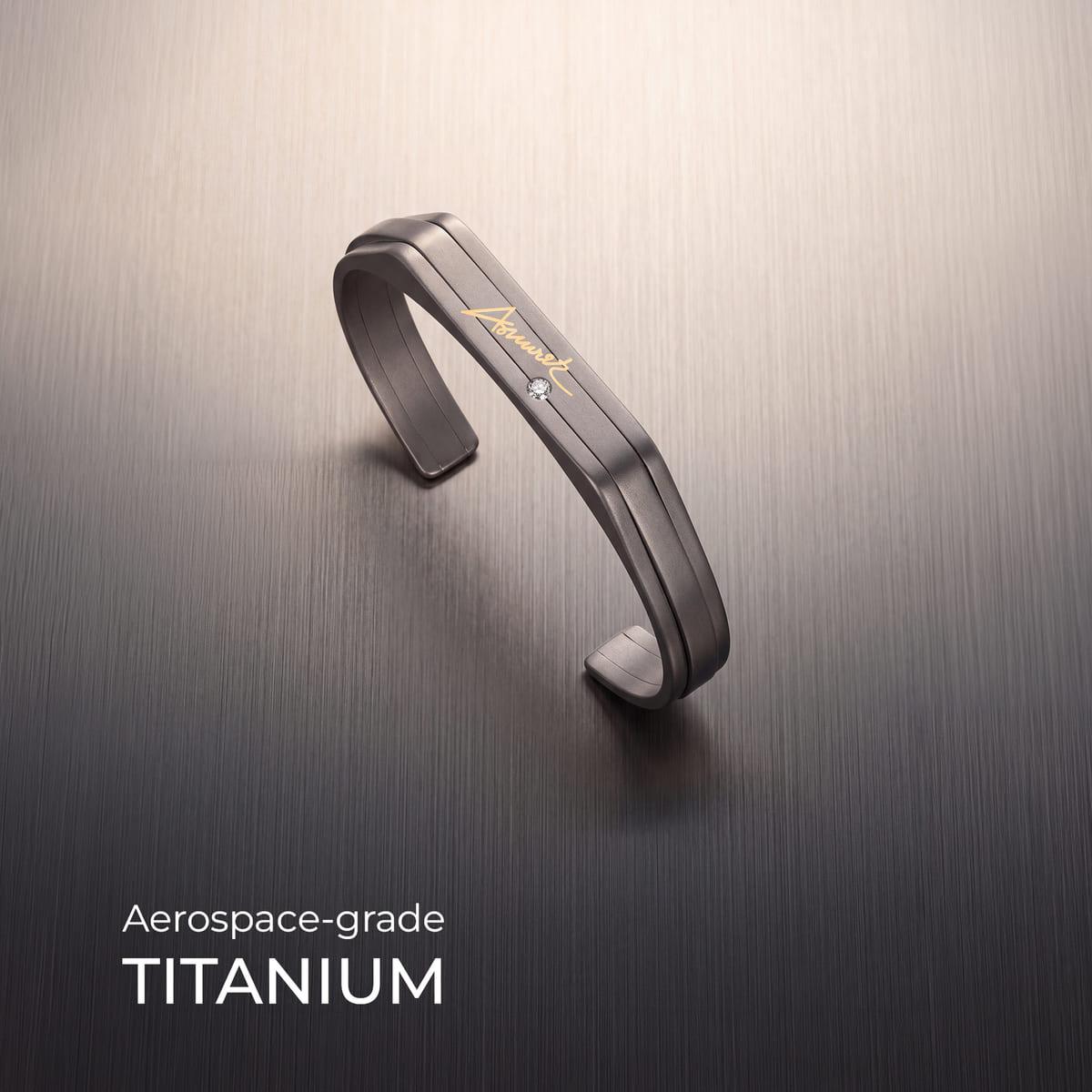
Image courtesy of AuTiC
Titanium isn't a new material — it was discovered in 1791 and has been used in aerospace engineering, medical implants, and military applications for decades. What's new is using it for jewellery, specifically wedding bands.
Most titanium rings are made from Grade 2 commercially pure titanium or Grade 5 Ti-6Al-4V — the same alloy used in aircraft frames and hip replacements. That's not marketing spin. It's the same specification, the same material. The result is a ring that's roughly 60% lighter than a platinum band, significantly harder than gold, and completely inert against human skin.
The natural colour is a cool, industrial grey — think polished steel but with a warmer undertone. It can be finished matte, brushed, or mirror-polished. It can also be anodised to produce colours — blue, purple, gold, even rainbow — without dyes or coatings, using an electrochemical process that creates a thin oxide layer on the surface.
Side-by-side
Every metal has trade-offs. Here's an honest comparison for wedding bands — not engagement ring settings, where the conversation is different. For those, see our metal types guide.
| Titanium | Platinum | 18K Gold | Tungsten | |
|---|---|---|---|---|
| Weight | Very light — you barely feel it | Heavy — noticeable presence | Medium | Very heavy — heavier than gold |
| Durability | Very high — flexes rather than deforms | High — metal displaces, doesn't wear away | Medium — softer, loses material over decades | Extremely high — but brittle, can shatter on impact |
| Scratch resistance | High — harder than gold or platinum | Low — develops patina quickly | Low — scratches easily | Very high — nearly impossible to scratch |
| Hypoallergenic | Yes — medical-grade biocompatibility | Yes | Sometimes — depends on alloy (nickel risk) | Yes — unless cobalt-bonded |
| Resizing | Difficult — half size stretch at most | Easy | Easy | Cannot be resized at all |
| Colour options | Natural grey, black, anodised colours | Silver-white only | Yellow, white, rose | Grey, black (plated) |
| Wedding band price | £50-£300 | £600-£1,200 | £300-£800 | £30-£150 |
Price note: These are plain wedding band prices. Adding inlays, diamonds, or mixed-metal elements pushes titanium toward the higher end of its range. See our Hatton Garden price guide for broader context on what rings cost.
The case for titanium
Titanium isn't trying to be gold or platinum. It's a fundamentally different material with its own set of advantages — and its own trade-offs. Here's both sides.
A titanium wedding band weighs roughly a third of the same ring in platinum. If you've never worn a ring before — which is most men buying their first wedding band — this matters. Many men say they forget they're wearing it within a day. With platinum or gold, the adjustment period is longer.
Titanium is harder than gold and platinum, which means it holds up better against daily wear — knocking into door handles, gripping tools, gym equipment. It won't bend out of shape like a gold ring can under heavy pressure. For men who work with their hands, this is the main selling point.
Titanium is the same metal used in surgical implants — hip joints, bone screws, dental posts. If you react to nickel (common in some gold alloys), cobalt, or copper (present in rose gold), titanium eliminates the problem entirely. It's biologically inert.
This is the biggest trade-off and we won't downplay it. Titanium cannot be soldered, so traditional resizing is impossible. Some jewellers can stretch a ring up by half a size, but that's the limit. If your fingers change significantly — weight gain, age, pregnancy — you may need a new ring. Get your ring size right the first time.
The lightness that's an advantage for some is a drawback for others. Some people want to feel their wedding ring on their finger — they want the weight as a constant reminder. Titanium doesn't give you that. If the heft of a gold or platinum band appeals to you, titanium will feel insubstantial.
Traditional Hatton Garden jewellers are set up for gold and platinum. Titanium requires different tooling — CNC machining rather than casting and soldering. You're more likely to find specialist titanium rings from online-first jewellers or dedicated titanium workshops than from a traditional shop window in Hatton Garden.
Wedding bands
The overwhelming majority of titanium ring buyers are men shopping for wedding bands. That's where titanium really shines — a daily-wear ring that needs to be tough, comfortable, and low maintenance.
Men's titanium bands are typically 6mm to 8mm wide — wider than most gold or platinum bands, which adds to the modern, bold aesthetic. The most popular finishes are brushed (satin) and matte, which hide daily wear better than a polished finish.
Popular styles include flat-profile bands with bevelled edges, domed comfort-fit bands, and textured designs (hammered, woodgrain, or carbon fibre inlay). Black titanium — achieved through either PVD coating or a deep anodising process — is particularly popular with men who want something that looks nothing like a traditional wedding ring.
Typical price range: £50-£200 for a plain band, £100-£300 with design elements or inlays.
Women's titanium rings are a smaller but growing market. They're typically narrower — 3mm to 4mm — and often incorporate design elements like rose gold inlays, small channel-set diamonds, or anodised colour accents. The result is a ring that's noticeably lighter and more comfortable than a gold band, with a contemporary look.
Where titanium is less common for women is engagement rings. While titanium engagement rings exist, the difficulty of resizing and the limitations on intricate stone settings make gold and platinum the more practical choice for engagement pieces. For wedding bands, though, titanium is a genuine option worth considering.
Design options
Pure titanium rings are clean and modern, but the real design interest comes from combining titanium with other materials. This is where titanium jewellery has evolved significantly in the last few years.
A titanium band with a gold inlay — a strip of 18K yellow, white, or rose gold running through the centre or along an edge — gives you the strength of titanium with the warmth and prestige of gold. The contrast between the cool grey of titanium and the warmth of yellow or rose gold is genuinely striking.
These two-tone designs are crafted by milling a channel into the titanium and pressing or bonding the gold inlay into place. It's precision engineering, not casting — which is why specialist jewellers tend to do this better than traditional goldsmiths adapting their existing methods.
Price range: £150-£350, depending on the width of the gold inlay and the karat.
Diamonds can absolutely be set in titanium — but the methods are different from gold or platinum. The two most common approaches are tension setting (the diamond is held by the spring force of the titanium itself) and channel setting (diamonds sit in a milled channel along the band).
Traditional prong settings are less common in titanium because the metal is too hard to manipulate prongs by hand. CNC-machined settings have largely solved this, but it requires a jeweller with titanium-specific tooling. If you want a diamond-set titanium ring, look for a specialist rather than asking a traditional jeweller to adapt.
Price range: £150-£400 for channel-set diamond titanium bands, depending on the number and quality of stones.
Before you buy
Titanium is a great choice for many people — but only if you go in with the right expectations. Here's our honest advice.
We cannot stress this enough. Because titanium rings are extremely difficult to resize, your ring size needs to be accurate before you order. Don't guess. Don't use a string-and-ruler method from the internet. Get professionally sized by a jeweller — ideally twice, at different times of day, because fingers swell in heat and shrink in cold. Our ring size guide covers this in detail.
A comfort-fit band has a slightly domed interior that slides over the knuckle more easily and sits more comfortably on the finger throughout the day. Because you can't easily resize a titanium ring, the comfort-fit profile also gives you a small margin for minor finger size fluctuations. We recommend comfort-fit for any wedding band, but especially for titanium.
A mirror-polished titanium ring shows every scratch. A brushed or satin finish disguises daily wear and actually improves with age — the accumulated micro-marks blend into the texture rather than standing out against it. If you want a low-maintenance ring that looks good in year five without any attention, go brushed.
Warm water, mild soap, and a soft cloth. That's it. Titanium doesn't tarnish, doesn't react with chlorine or salt water, and doesn't need professional cleaning. If the ring picks up scratches, you can restore a brushed finish yourself with a fine Scotch-Brite pad. For polished finishes, a jeweller's polishing wheel brings it back to mirror shine in minutes. No special solutions, no ultrasonic cleaners required.
Our take
Titanium is not for everyone — and that's fine. Here's who we think it's genuinely well-suited for.
Not sure where to start? Our guide to Hatton Garden jewellers includes jewellers who stock or can source titanium wedding bands, alongside traditional gold and platinum options.
Keep exploring before you make your decision.
The full comparison of traditional precious metals for rings — durability, maintenance, and real prices
Everything you need to know about choosing wedding bands, from metals to styles to matching pairs
How to measure your ring size accurately — especially important for metals that can't be resized
Prices, styles, and how to walk into Hatton Garden with confidence instead of confusion
Our honest guide to who does what well — including jewellers who work with alternative metals
Real price ranges so you know whether a quote is fair before you hear it
Yes. Despite what you may have heard, titanium rings can be removed in an emergency. Hospital A&E departments and fire services carry ring cutters that work on titanium — they use a diamond-tipped blade or a specialised vice-grip cracker rather than the standard ring cutter used for gold. It takes slightly longer than cutting gold, but it is absolutely possible. No responsible jeweller would sell a ring that couldn't be removed in an emergency.
In most cases, no. Titanium cannot be soldered or reshaped like gold or platinum. Some jewellers can stretch a titanium ring up by half a size, but going down in size or making significant adjustments isn't feasible. This is why getting your size right before ordering is critical. We recommend getting professionally sized at least twice — once in the morning and once in the evening — before committing to a titanium ring.
Yes — titanium is one of the most biocompatible metals available. It's the same material used in medical implants, surgical instruments, and dental fixtures. If you've ever had a reaction to nickel, cobalt, or copper in other jewellery, titanium is one of the safest alternatives. Allergic reactions to titanium are extremely rare — documented cases exist, but they're measured in the single digits across medical literature.
Titanium is harder than gold and platinum, so it resists scratches better than traditional precious metals. However, it's not scratch-proof — no metal is. The difference is that titanium scratches can usually be brushed or polished out at home with a Scotch-Brite pad or fine sandpaper, which you cannot do with gold or platinum without a jeweller's equipment. A brushed titanium finish actually hides wear better than a polished one.
A plain titanium wedding band typically costs between £50 and £150. Add design elements — inlays, diamonds, or mixed metals — and you're looking at £150 to £300. Compare that to a plain platinum band at £600-£1,200 or an 18K gold band at £300-£800. The price difference isn't because titanium is inferior — it's because titanium is abundant and lighter, so less raw material is needed per ring.
Titanium is non-ferromagnetic, meaning it doesn't trigger standard metal detectors in the way steel or iron would. Most people report walking through airport security without their titanium ring causing any issues. That said, highly sensitive detectors can pick up any metal, so it's not guaranteed. It's never a problem — you'd simply be asked to show it's a ring.